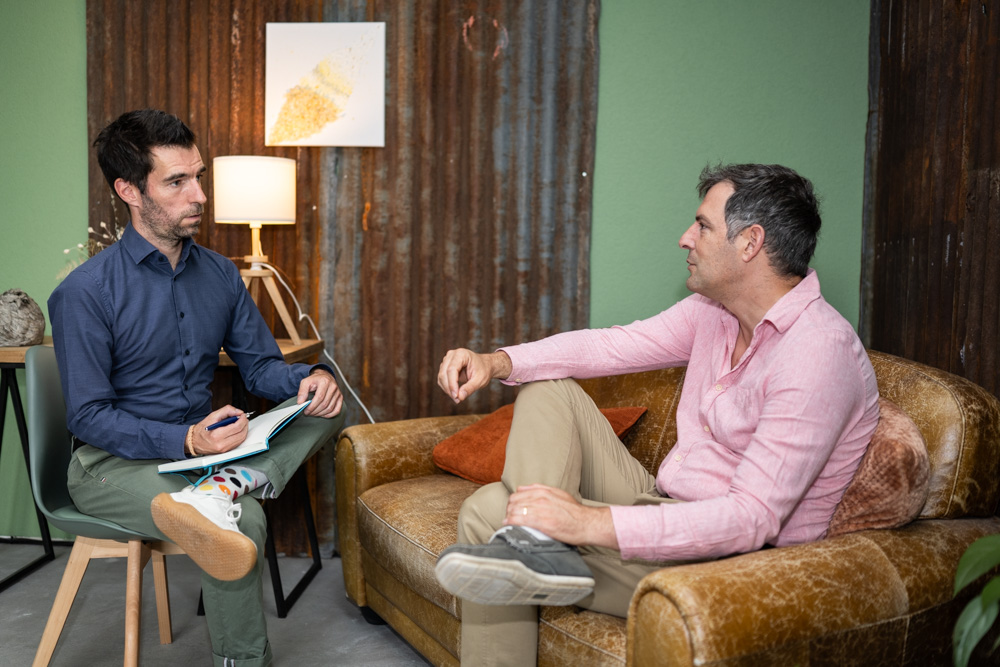


I work with CTOs, VP Engineering and Heads of Engineering and managers of Swiss tech companies to build spaces you walk out of with more clarity and more energy.
Lead by presence,
not pressure.
When teams stop running on fumes and recover their power, joy becomes a source of performance — not a motivational gimmick.
Three stories tech tells itself about leadership. They reinforce each other. Together, they produce teams that are technically brilliant and humanly exhausted.
A manager who makes room for what's actually happening supposedly can't make hard calls anymore. Care, the story goes, undermines standards. The opposite is true: care is what makes high standards sustainable.
Something you learn from a book, measure in OKRs, certify with Scrum Alliance. One more line on the CV. But teams don't follow Confluence pages — they follow a clear signal.
The motivational coach who challenges, pushes people out of their comfort zone. A weekly motivation session to ship faster. Your managers don't need a locomotive — they need room and clarity.
Together, these stories produce organisations that go in circles.
That replay the same meetings, the same conflicts, the same decisions never quite made. That watch their best people leave without understanding why. That end up mistaking exhaustion for seriousness.
It took me fifteen years to realise I was bulldozing solutions instead of aligning my teams.
My job today is to make sure it doesn't take you as long.

The same situations, seen from two different shores. The shift doesn't come from a new framework — it comes from the quality of the space you build.
Technically strong, humanly expensive. Nobody knows what to do anymore. The team pays the bill in silence.
Resurfacing every two months in a slightly different form. Never quite made, never quite buried. A silent leak.
Parallel teams. They've stopped talking. They rebuild what the team next door already shipped. They wrap services they no longer trust.
Set because that's the process. They guide no one. Rewritten, almost identically, the following quarter.
You celebrate the people who put out fires. You forget the ones who keep them from starting. Eventually, everyone becomes an arsonist.
The avoided conflict, the manager in distress, the team slowly falling apart. Never prioritised. It compounds — exactly like technical debt.
Before the crisis. There's a way to receive them, name them, settle them calmly. The team stops working around what has gone wrong.
Because they were made in a space where everyone could say what they needed to say. No weak consensus, no silent sabotage.
Boundaries become porous without becoming blurry. Information flows. Work stops getting done twice.
They become a tool for alignment and prioritisation. Not a quarterly ceremony with no real bite.
The quiet moves, the conversations that defuse, the calls that head off the fire. You no longer need a disaster to be recognised.
Not the forced enthusiasm of kick-offs and all-hands. The sober joy of building something meaningful together. A signal that the system has started generating energy instead of consuming it.
If you recognise two of these, we have something to do together.
Book a 30-min callTeams kept passing responsibility back and forth. Projects were slow. Consultants could no longer commit to deadlines.
Cross-functional restructuring aligned around the value chain. Friction sharply reduced. Lasting adoption through participatory change management.
Software team under constant tension. Fuzzy priorities, low delivery despite high effort. Visible fatigue.
Delivery tripled — no new hires, no forcing. Stress noticeably down. The team got its enjoyment back, and that's what unblocked the rest.
Scaling a team fast while preserving culture, cohesion, and quality of service.
Team scaled without breakage. Smooth onboarding for new hires. Culture not just preserved, but strengthened by the growth.
At first, they wanted to vent: leadership, the absurdity of the calls being made, what was being imposed on them. Legitimate — and not enough.
A shift, not a leap, from complaint toward what was actually possible. They still work together. They've stopped complaining. They act.
Build spaces where what matters can be said, decided, and hold up over time.
One tight week to name the loops replaying in your teams and your leadership rituals. You leave with a clear read and a first concrete move to make.
Weekly face-to-face sessions. A place to put down what weighs, name what's stuck, prepare what matters.
Available between sessions by message or phone for moments that count.
Regular work with your managers — individually and as a group. They become able to hold human topics without routing everything back to you.
Your exec team needing to make a structural call. Your annual offsite. A team disagreement to untangle before it does lasting damage.
With you it's always remarkable. We spend 20 minutes talking about anything, and then we settle the real question in 5 minutes.
Those 20 minutes "of anything" — most tech executives would cut them. I protect them. They're what makes the decision possible.
I thought coaching was mostly useless — one of those management fads that pass. I agreed to play along, sceptically. I was wrong. REALLY wrong.
Today I feel so much more grounded, focused, solid. We built simple, practical mechanisms that strengthen my ability to stay focused.
With Gilles, you go deep, fast. He's one of the people who's taught me the most about myself as a leader.
I found my inner stability. I feel more flexible and more steady at the same time. My teams feel it too.
I was able to dig into the source of my beliefs in a setting that was serious, caring and light all at once — a very subtle, very welcome balance.
I came out with a clear view of new behaviours to test, then adopt. The path is sharper.
Gilles is one of the people who's taught me the most about managing teams. He has a way of bringing energy and a deeply positive momentum.
A real pleasure to carry projects together, sharing essential values: cooperation and transparency.
Thirty minutes. You tell me where it stings. I tell you whether I can be useful. No endless form, no automated email sequence.